

VF tires: a technology that offers benefits in agriculture
Greater traction when conditions become more challenging
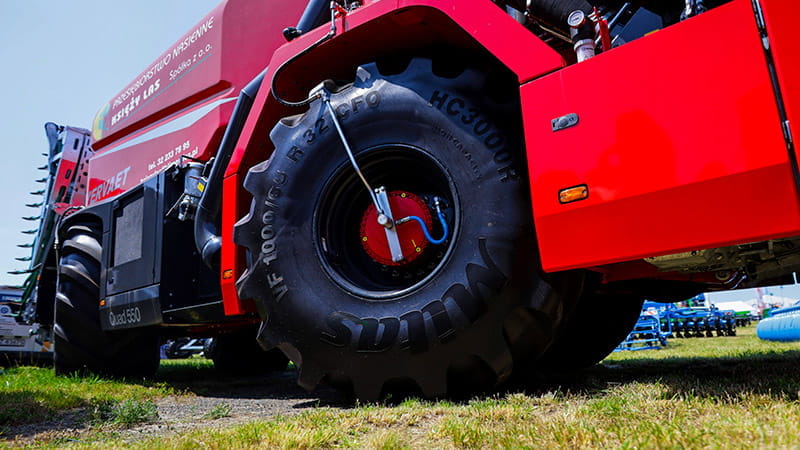
A larger contact area allows the tractor to transfer its power to the ground more effectively. In other words, it improves the traction coefficient, one of the parameters that determines how efficiently the machine can make use of its available power.
The result is reduced wheel slip, a phenomenon that is particularly common in challenging field conditions, whether the soil is excessively wet or excessively dry.
Less wheel slip means greater pulling capacity, improved efficiency during field operations and tangible economic benefits through reduced tire wear and lower fuel consumption.
Why VF tires are becoming increasingly popular
The VF (Very High Flexion) marking identifies a construction standard recognised by the ETRTO (European Tyre and Rim Technical Organisation). It allows a tire to carry up to 40% more load than a standard tire at the same inflation pressure or, conversely, to carry the same load while operating at an inflation pressure that is 40% lower. It is this second capability that makes VF tires particularly suitable for many agricultural applications, especially when the goal is to improve efficiency without compromising soil health.
Greater respect for the soil without compromising performance
One of the main reasons why farmers choose VF tires is their ability to help protect the soil.
By operating at lower inflation pressures, the machine's weight is distributed over a larger contact area. This means that less pressure is exerted on the soil, helping to limit soil compaction.
This is far from a minor consideration. Compacted soil loses porosity, drains water less effectively, becomes less aerated and can create problems for root development. Over time, all of this results in reduced soil fertility and lower productivity.
By increasing the footprint, VF tires help preserve soil structure without compromising the machine's operating performance.
You can read the article dedicated to this topic on our blog.
Better self-cleaning helps improve performance
When discussing field performance, the focus is often placed exclusively on traction and pulling capacity. However, there is another aspect that can make a difference: the tire's ability to release soil and mud naturally.
The greater flexibility of VF tires can help improve tread self-cleaning, that is the ability to expel the soil and mud trapped between the tread lugs during field operations.
This process is made possible by the tire's continuous deformation. During ground contact, the casing compresses before returning to its original shape as the tread section lifts away from the ground during rotation. This movement helps release the soil accumulated between the tread lugs.
You can learn more about this process and all its benefits by reading the dedicated article on our blog.
VF tires for every application
The ability to operate at low inflation pressures allows agricultural machinery, especially heavier machines, to have less impact on soil fertility by significantly limiting soil compaction.
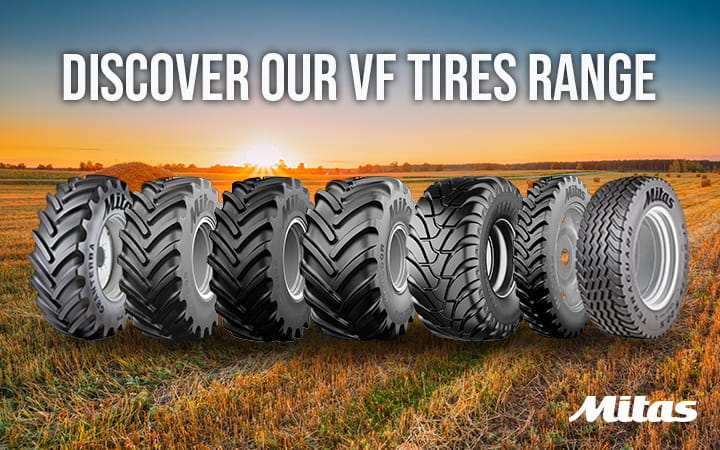
GRANTERRA, the Mitas tire specifically designed for high-horsepower tractors, is a perfect example. Its generously sized tread lugs provide excellent traction even in the most demanding working conditions, while its wide footprint helps protect the soil.
Another VF tire particularly suited to this category of tractors, as well as to self-propelled sprayers and spreaders, is the HC 2000. Its innovative tread design and internal construction help reduce fuel consumption while also reducing road noise and vibrations.
The HC 3000, designed for the drive axle of combine harvesters and self-propelled forage harvesters, follows the same principle: offering an high-performance solution without compromising soil health.
In these applications, the ability to operate at low inflation pressures also plays a crucial role in increasing traction because, in some cases, harvesting must be carried out in difficult field conditions in order to make the most of the available harvesting window.
The HC 3000 is also available in the "R" version, featuring rounded shoulders to reduce its impact on grassland and promote crop regrowth.
Whenever a narrow tire is required to enter fields where crops have already been established while limiting crop damage, the HC 1000 is the ideal solution. Designed for self-propelled sprayers and operations on wide-row crops, its VF technology helps reduce wheel slip and increase traction, improving both machine performance and fuel consumption.
It is not only tractors and self-propelled machines that require high-performance tires. Implements also need tires capable of maximising pulling efficiency, ground contact and road transport performance.
For these applications, TERRAGUARD is the ideal solution. Its saw-tooth tread pattern improves rolling efficiency and reduces vibrations during transport. In this respect, the square shoulder profile plays a key role.
Trailers also play an important role in preserving soil structure and fertility. Here, VF technology, available for example on Mitas AGRITERRA ULTRA SOIL PROTECTOR tires, provides benefits both in the field and during road transport by allowing heavier loads to be carried at the same inflation pressure compared to standard tires.
A solution that adapts to different operating needs
Agricultural businesses often operate in very different conditions throughout the same day, from field operations and road transport to moving equipment or agricultural products.
The ability to easily increase or decrease inflation pressure, together with the growing adoption of central tire inflation systems that allow operators to make these adjustments directly from the cab, makes VF tires one of the most versatile solutions currently available on the market.